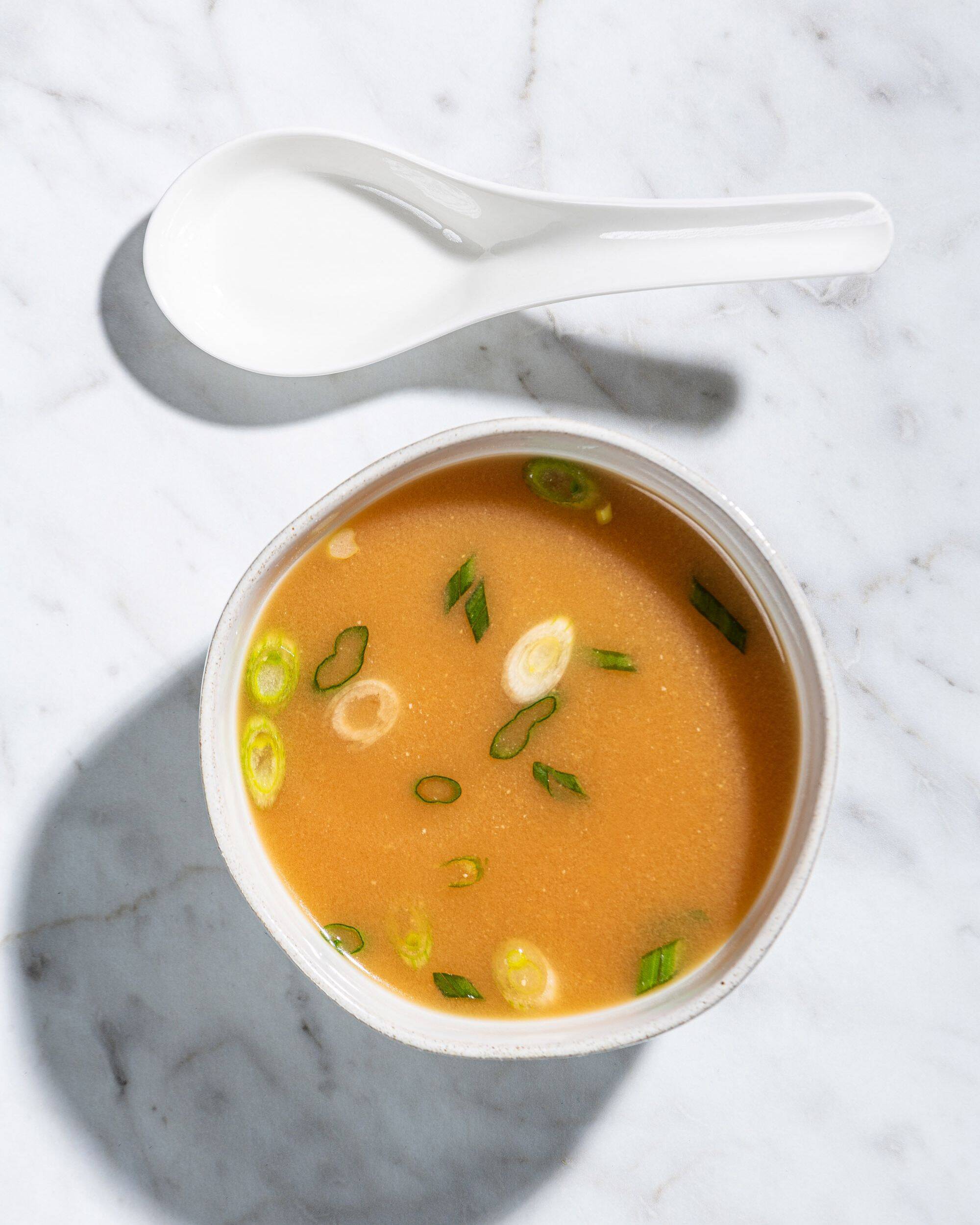
| Did a friend forward this to you? Sign up here. A moment for miso There are many ways to use miso in everyday cooking. Baker and blogger Aran Goyoaga adds miso to cake batter in her newest cookbook, "Cannelle et Vanille Bakes Simple." In "Greenfeast: Autumn, Winter," cookbook author Nigel Slater uses miso as a crunchy coating for sauteed Brussels sprouts. In their book, "Ideas in Food," chefs Alex Talbot and Aki Kamozawa augment pasta dough with miso. The fermented paste, an essential ingredient in Japanese cooking, has been used as a cheese-y cheat and fast marinade, in dressings and sauces, braises and roasts. Indeed, it's "a seasoning powerhouse with tons of range," as my colleague Aaron Hutcherson wrote in his recent guide to miso. But to appreciate miso in perhaps its purest expression, consider miso soup. Sipped out of a small bowl, misoshiru is an essential part of many Japanese meals. At its most basic, it consists of miso stirred into hot broth, at a ratio of 1 tablespoon of miso to 1 cup of broth. Because the saltiness of miso can vary significantly, Sokono Sakai, instructor and author of "Japanese Home Cooking," notes that cooks should adjust the ratio to their tastes. The broth is traditionally dashi, a simple stock, and the simplest dashi is made by simmering a strip of kombu, a type of kelp, in water. There are, of course, many types of dashi; it can be made from bones, vegetable trimmings, mushrooms, herbs or fermented fish. The recipe below is for a common dashi made from kombu and bonito flakes, shavings from a block of cooked, smoked, dried and pressed bonito, or skipjack tuna. Together, the kombu and bonito add richness and an oceanic minerality to the clear broth. Once the dashi is ready, other ingredients may be added, either pre-cooked or to cook in the broth: tiny prawns, cubes of silken tofu, clams, mushrooms, greens, cabbage, squash, potatoes or other root vegetables, eggs, noodles, citrus zest, scallions. Keep seasonality and simplicity in mind when you decide what to add to your miso soup. It's meant to "whet your appetite, and that first sip will bring you the taste of the season," Sakai writes. A summer-y miso soup might feature tomatoes and corn; in the winter, dried mushrooms and root vegetables could be added. The last step is the most important: With the dashi just warm — but never boiling — miso is added. Instantly, the broth turns cloudy and creamy. But delicious secrets hide below its murky surface. In the simplest miso soup, the miso's nutty umami shines. In variations with many additions, the miso provides a well-lit stage, a bold backdrop to whatever goodness the season may bring.  | Today's recipe | 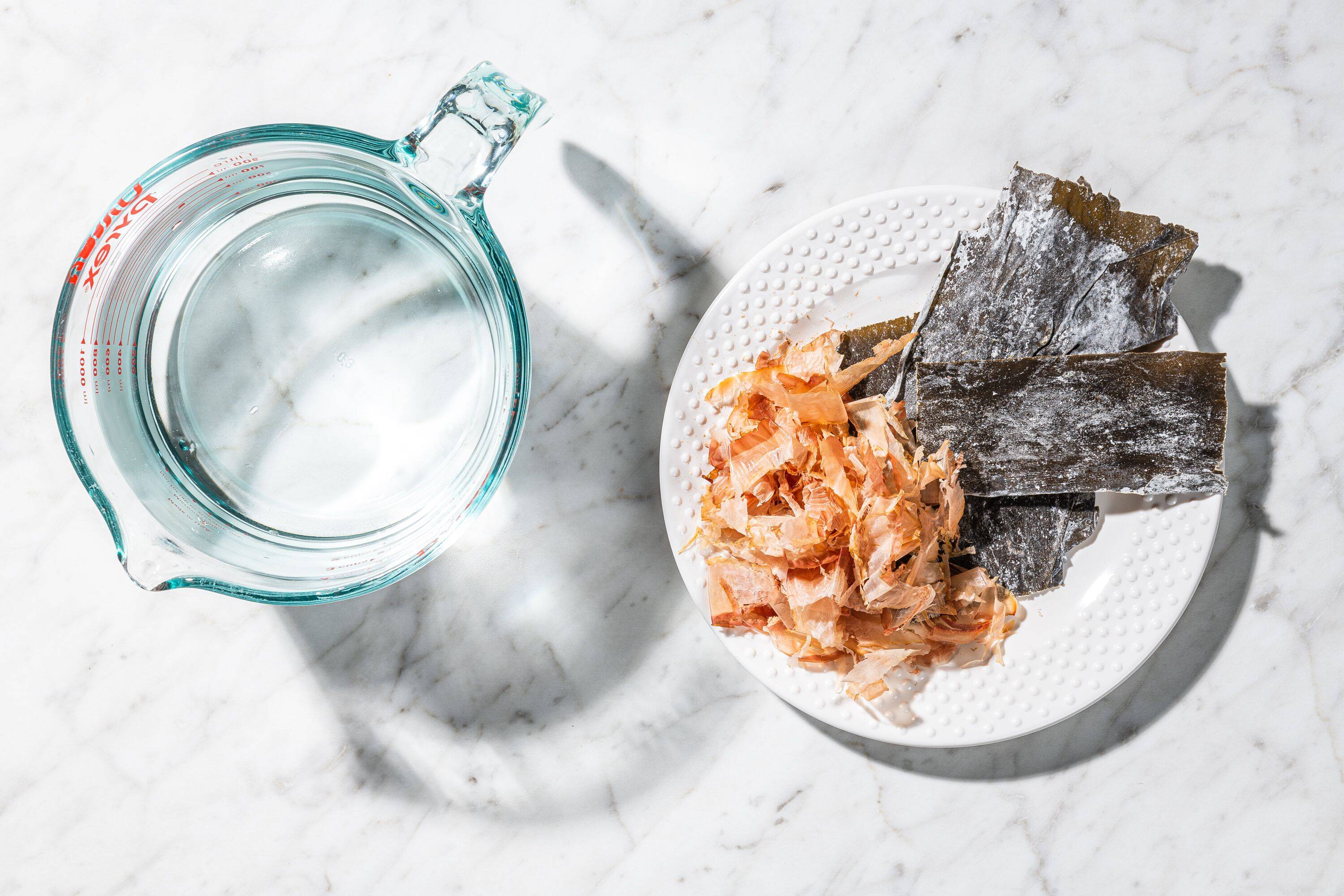 Photos by Rey Lopez for The Washington Post; food styling by Marie Ostrosky for The Washington Post | Miso SoupThis recipe is for a very basic miso soup. Here are ways to adapt it to your tastes, using what you have on hand. The only essential ingredient here is miso. - Want to make the dashi vegan, or just don't eat fish? >> Omit the bonito flakes.
- Can't find kombu? You can order it online >> or use any kind of store-bought or homemade stock as the base for your miso soup.
- The miso is a must >> but if you are sensitive to salt, start with half as much, and then taste the soup, adding more as needed.
- To make this a meal, add: cooked noodles or rice; cooked and pulled chicken, meat or fish; whole shellfish; finely sliced or chopped hardy greens, squash, sweet potatoes, broccoli or cauliflower; cubes of tofu; sliced mushrooms; a couple of scrambled eggs, which will poach in the warm broth.
Want to save this recipe? View it on Voraciously here and click the bookmark icon below the serving size at the top of the page to add it to your Reading List. For easy printing and scaling, view this recipe in our Recipe Finder. Servings: 4 (about 4 cups)
Active time: 15 mins
Total time: 35 mins IngredientsFor the dashi - 4 cups water
- 1 (3-by-4-inch) piece kombu
- 1 cup bonito flakes
For the miso soup - 4 cups dashi (from the recipe above)
- 3 to 4 tablespoons miso (preferably 2 tablespoons aka [red] miso and 2 tablespoons shiro [white] miso)
- 1 1/2 tablespoons mirin, cooking sake or soy sauce (optional)
- 2 scallions (white and green parts), minced (optional)
Steps1. Make the dashi: In a medium pot over medium-high heat, bring the water and kombu to almost but not quite a boil. Remove from the heat and, using tongs, remove and discard the kombu. Add the bonito flakes and set aside, uncovered, for about 15 minutes. The bonito should sink to the bottom of the pot. Strain, several times if necessary, until the broth is clear. The dashi is most flavorful when used right away; you can refrigerate it until needed but its flavor will start to diminish after 1 day. 2. Make the miso soup: In a medium pot over medium heat, heat the dashi until hot but do not let it come to a boil. Remove from the heat. 3. In a medium bowl, whisk together the miso with about 1/2 cup of the hot dashi until the miso is incorporated into the liquid. Pour this mixture back in the pot and stir to combine. Season to taste with mirin, sake or soy sauce, if desired. Add scallions, if using, and serve. (The miso causes the soup to become cloudy after it sits for a few moments. This is okay.) Dashi recipe adapted from chef Koji Terano. Miso soup recipe adapted from a recipe by writer Renee Schettler. Tested by Ann Maloney. Ingredients are too variable for a meaningful analysis.  | Dessert | 🍪 Cookie of the Day: Chewy Cranberry Coconut Oatmeal Cookies.
🎧 Sinfonia Concertante for Four Winds in E Flat Major.
📖 Five small switches you can make to be more eco-friendly.
📺 "Dog" the official trailer.
👀 Pretty bandanas.
🗣 If you liked this newsletter, please forward it to a friend! |



 Email
Email 


